

Behind the Scenes: Creating the 13-Foot Southfield Tile Mural | Whistling Frog Tile
/
The Art of the Mural: Handcrafting the 13-Foot Southfield Obelisk
At Whistling Frog Tile, every piece we create tells a story, but some stories are larger than others—literally. Today, we’re taking a birds-eye view of a specific portion of a massive tile mural project: the 13-foot tall obelisk that still stands in Southfield today.
The Layout: Swirling Ribbons of Blue
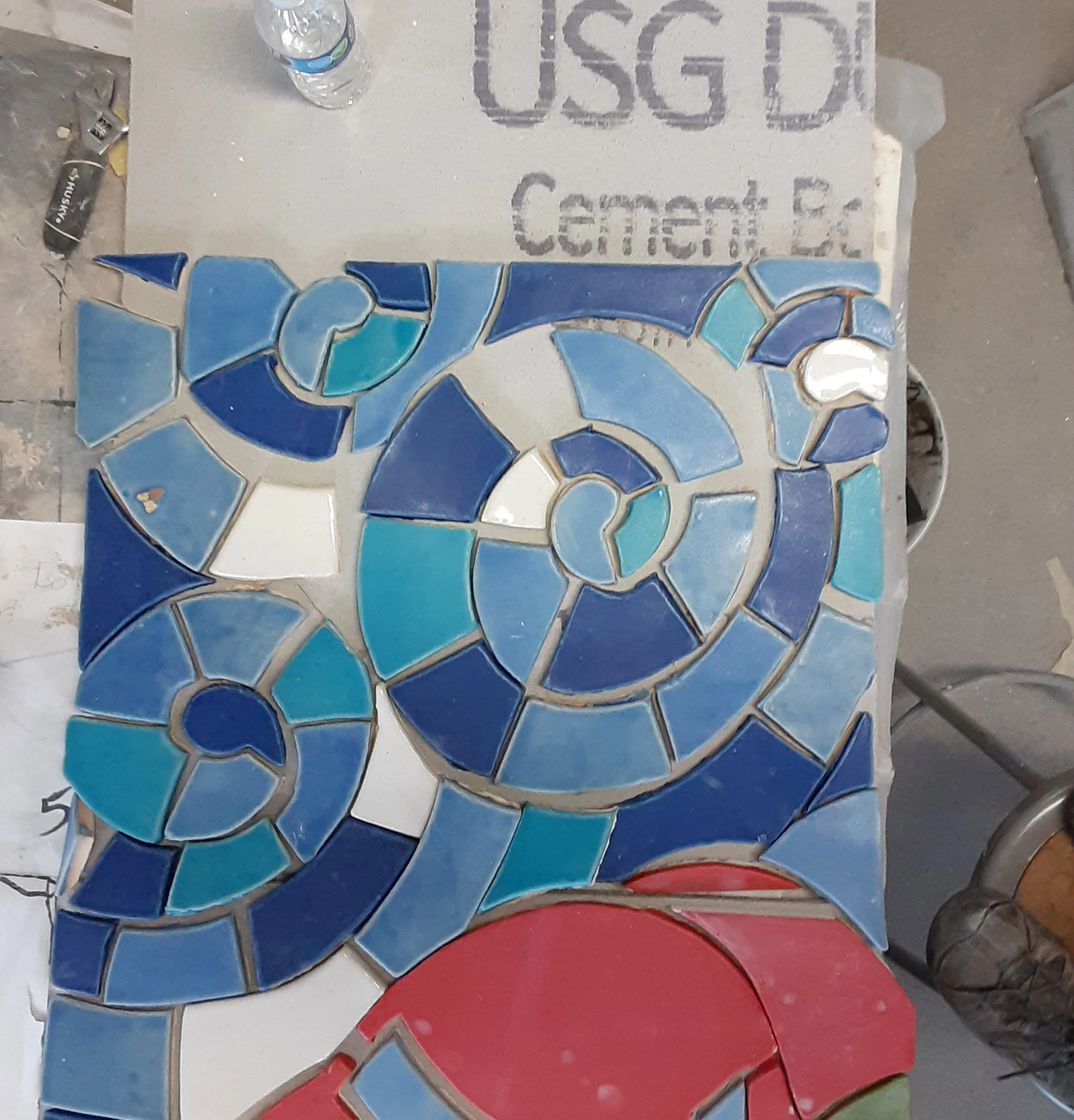
The process begins with a meticulous layout. In the studio, you’ll see swirling ribbons of color—navy blue, sky blue, aqua, and crisp white. These spirals are broken into small, mostly rectangular shapes, aligned in their proper order before grouting.
Each of these hand-glazed ceramic shapes is numbered on the back, corresponding to a master map created by Rick.
From Paper to Clay: The "Pouncing" Technique
How do we transfer a grand vision onto raw clay? We use a traditional method involving a long scroll of paper laid over joined slabs of clay.
Pouncing: Using a 'pouncing tool,' Hubert creates tiny perforations along Rick’s design lines.
Charcoal Outlining: We gently tap a small bag of charcoal over the paper. The dust filters through the holes, leaving a perfect charcoal outline on the clay below.
Precision Cutting and "Fake Grout Lines"
Once the paper is removed, the carving begins. We use a small loop tool for the initial cuts. We only go about halfway through the clay at first to prevent the tools from breaking and to ensure precision.
Interestingly, not every line is a separation. We use implied grout lines within larger pieces to add texture and detail without breaking the structural integrity of the ceramic.
The Final Countdown: Drying and Installation
Finally, a releasing cut is made to separate the individual tiles. Each piece is numbered one last time before being moved to a baker's rack for the drying process.
This specific project resulted in a stunning 13-foot tall tiled obelisk, a landmark of architectural ceramic art that continues to brighten Southfield.